

On-Demand Swag vs Bulk Ordering
Updated: May 19
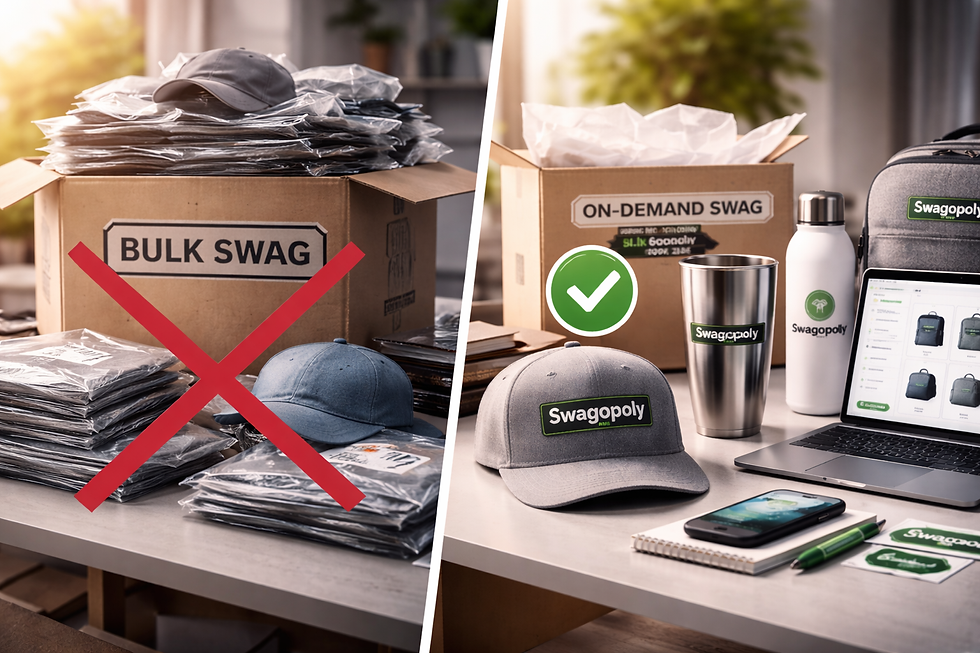
For years, bulk ordering was the default way companies managed branded merchandise. Order in large quantities, store it somewhere, and distribute it over time.
In 2026, that model is breaking.
Rising costs, wasted inventory, and changing employee expectations are forcing businesses to rethink how they approach swag. What’s replacing it isn’t just a new trend, it’s a smarter system.
At Swagopoly, we’ve seen this shift firsthand. Companies are moving away from bulk ordering and adopting on-demand, automated swag systems that reduce waste, improve efficiency, and scale with growth.

The Problem with Bulk Ordering
Bulk ordering looks cost-effective on the surface. Lower unit pricing, fewer transactions, and predictable inventory.
But in reality, it creates hidden problems that most businesses underestimate.
Companies often order based on assumptions, how many employees they have today, what sizes they think people will need, or what products might be popular. The result is overproduction.
Industry insights suggest that 30–40% of bulk-ordered merchandise often goes unused. Items sit in storage, become outdated, or simply never get distributed.
On top of that, businesses deal with:
Storage costs and inventory management
Manual distribution to teams or locations
Outdated branding as products sit unused
What seemed efficient quickly turns into operational overhead.
The Rise of On-Demand Swag
On-demand swag flips the model entirely.
Instead of producing items upfront, products are created only when someone orders them. This is powered by print on demand apparel and automated fulfillment systems.
This approach aligns with broader market trends. The global print-on-demand industry is growing rapidly, driven by demand for personalization, sustainability, and efficiency.
More importantly, it aligns with how modern businesses operate:
Leaner systems
Less waste
More flexibility
On-demand isn’t just a production method, it’s a shift toward smarter infrastructure.
The Problem with Bulk Ordering
Bulk ordering looks cost-effective on the surface. Lower unit pricing, fewer transactions, and predictable inventory.
But in reality, it creates hidden problems that most businesses underestimate.
Companies often order based on assumptions, how many employees they have today, what sizes they think people will need, or what products might be popular. The result is overproduction.
Industry insights suggest that 30–40% of bulk-ordered merchandise often goes unused. Items sit in storage, become outdated, or simply never get distributed.
On top of that, businesses deal with:
Storage costs and inventory management
Manual distribution to teams or locations
Outdated branding as products sit unused
What seemed efficient quickly turns into operational overhead.
Why Businesses Are Making the Switch
The move toward on-demand swag is being driven by three key factors: efficiency, experience, and scalability.
Efficiency Without Waste
With on-demand production, there is no excess inventory. Every item is created with a purpose, because someone actually wants it.
This eliminates:
Overstock
Dead inventory
Guesswork in ordering
It also supports sustainability goals, which are increasingly important for modern brands.
Better Experience for Employees and Customers
Bulk swag often leads to generic items that don’t fit well, aren’t used, or don’t reflect personal preferences.
On-demand systems allow individuals to:
Choose their size
Select products they actually want
Order when they need it
This improves engagement and ensures that branded merchandise is actually used—turning it into a meaningful brand touchpoint rather than a disposable giveaway.
Built for Scale
As companies grow, bulk ordering becomes harder to manage.
What works for 20 employees breaks at 200. Distribution becomes complex, inventory tracking becomes messy, and reordering becomes reactive.
On-demand systems, especially when built through company branded microstores, scale naturally. Whether you have 10 employees or 1,000, the system remains consistent.
There’s no need to predict demand, the system adapts automatically.
The Financial Reality: Bulk vs On-Demand
One of the biggest misconceptions is that bulk ordering is cheaper.
While unit costs may be lower upfront, the total cost of ownership tells a different story.
Bulk swag includes:
Wasted inventory
Storage expenses
Manual labor for distribution
Reordering inefficiencies
On-demand swag removes these hidden costs.
Instead of paying for products that may never be used, businesses invest only in what is actually ordered. This makes budgeting more predictable and aligned with real usage.
For finance teams, this shift changes swag from a sunk cost into a controlled, measurable investment.
From Products to Systems: The Real Shift
The biggest change isn’t just how swag is produced, it’s how it’s managed.
Traditional swag programs are product-focused. On-demand systems are system-focused.
With a modern company swag store, businesses can:
Centralize all branded merchandise
Allow employees or customers to order directly
Automate fulfillment and delivery
Maintain brand consistency across all products
This removes the need for manual coordination and creates a streamlined experience.
How Swagopoly Powers On-Demand Swag
At Swagopoly, we’ve built our platform around this exact shift.
Instead of managing inventory, spreadsheets, and distribution logistics, businesses use:
Company branded microstores to centralize their merch
Print on demand apparel to eliminate overproduction
Automated fulfillment systems to handle production and shipping
This creates a fully managed ecosystem where swag is no longer a burden, it becomes a scalable asset.
Whether it’s an employee uniform store online, onboarding kits, or customer merchandise, everything operates within a single system.
Real Insight: Why This Shift Matters Now
The move away from bulk ordering is not temporary, it’s a response to how businesses operate today.
Remote teams, global workforces, and fast-changing brand needs require flexibility. Bulk inventory simply cannot keep up.
On-demand swag aligns with:
Modern workforce distribution
Sustainability expectations
Data-driven decision-making
It allows businesses to stay agile while maintaining strong brand presence.
Final Thoughts
Bulk ordering served its purpose in the past, but it no longer fits the needs of modern businesses.
On-demand swag offers a smarter alternative, one that reduces waste, improves user experience, and scales effortlessly.
The companies making this shift are not just saving time and money. They are building systems that support long-term growth.
Real Questions Businesses Ask About On-Demand Swag
Is on-demand swag more expensive than bulk ordering?
Not when you consider total costs. On-demand eliminates waste, storage, and unused inventory, making it more cost-efficient overall.
What is print-on-demand apparel?
It’s a production method where items are created only after an order is placed, removing the need for inventory.
Can on-demand swag work for large companies?
Yes. It’s designed to scale and works especially well for growing teams and distributed workforces.
How does a company swag store work?
It’s an online store where employees or customers can order branded products directly, with automated production and delivery.
Is on-demand swag better for sustainability?
Yes. It reduces overproduction and waste, aligning with modern sustainability goals.


Comments