

Branded Merchandise Is a Strategy—Not an Afterthought
Updated: Dec 9, 2025
Tangible Products Power Campaigns, Events & Omnichannel ROI
In a digital-first marketing world, brand leaders obsess over impressions, click-through rates, and fleeting bursts of attention. But as algorithms shift and digital noise increases, marketers are rediscovering something vital: the power of physical brand touchpoints.
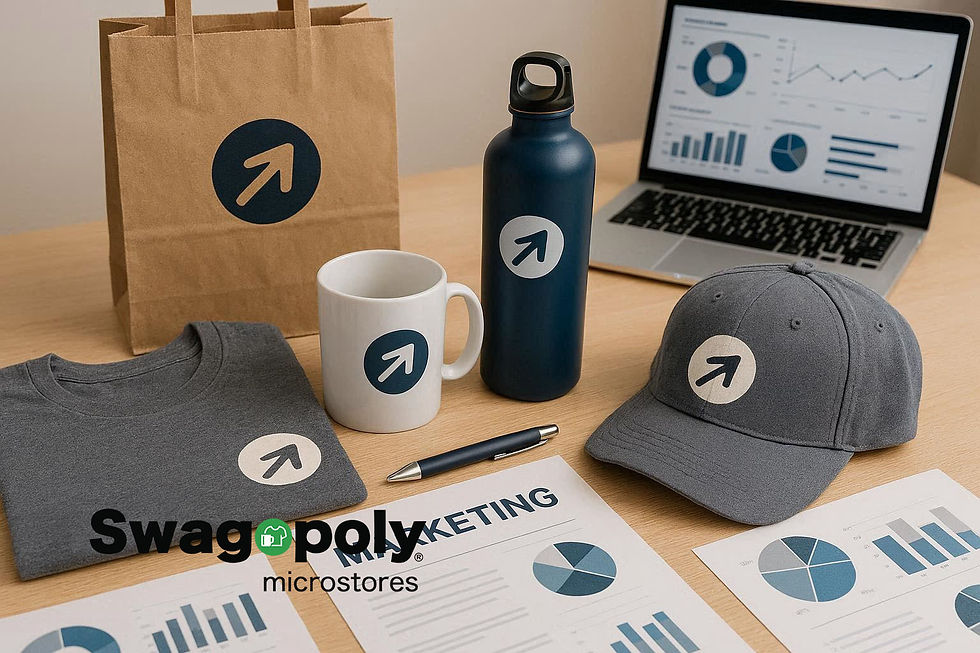
Unlike digital ads that vanish in seconds, branded merchandise lives on desks, in backpacks, in offices, at events, in homes, and across social feeds. It becomes a physical ambassador for your brand—visible long after a campaign ends. That’s why more companies are elevating merchandise from a “nice-to-have” to a core promotional marketing strategy, using physical items to fuel campaigns, partnerships, events, and retention initiatives.
Meanwhile, scalable platforms like Swagopoly Microstores let companies activate merchandise with unprecedented efficiency, ensuring every campaign—digital or physical—can leverage swag that is consistent, on-brand, and easy to distribute.
Let's dig deeper into how branded merchandise is transforming modern marketing, why it delivers stronger ROI than many traditional channels, and how companies use it to power omnichannel strategies that attract, engage, and retain customers at scale.
Additional perspectives: "The Strategic Power of Branded Merchandise in Modern Marketing"
How Branded Merchandise Became a Modern Marketing Strategy Driver
For years, branded merchandise was treated as a giveaway or a low-level tactic. But today’s most successful brands treat merchandise as a strategic asset.
Here’s why:
Reason #1: Digital fatigue has made physical engagement more valuable.
Consumers see up to 10,000 digital messages per day. But they may use the same branded tumbler, hoodie, or tech accessory hundreds of times.
Reason #2: Branded products create lasting touchpoints.
Unlike digital ads—which disappear once the budget stops—branded items keep working as long as they’re used.
Reason #3: Merchandise sparks organic reach and emotional alignment.
People proudly post, wear, and share products that feel meaningful or useful. This creates earned media and trust-building visibility.
Reason #4: Modern technology makes swag scalable and data-driven.
With integrated solutions like Swagopoly Microstores, marketers can coordinate merchandise across events, teams, and locations without operational headaches.
The result: More companies are using merchandise as the backbone of their promotional marketing strategy, not as a line item buried in event planning.
Branded Merchandise Campaigns: From “Extras” to High-Impact Brand Builders
When merchandise becomes central to your campaign—not an afterthought—it becomes a memorable brand experience.
Below are four campaign types where branded merchandise excels.
Campaign Type 1: Product Launches
A launch is more than an announcement—it’s a moment.Branded merchandise makes that moment tangible.
Popular swag for product launches includes:
custom apparel for employees and early adopters
influencer mailers
customer kits with product samples and accessories
event giveaways that build anticipation
themed packaging that reinforces the narrative
Effective branded merchandise campaigns tie the product’s story into the items themselves.
Example:A fitness tech company launched a smartwatch and included:
a branded sweat towel
a motivational wristband
a premium water bottle
These items turned the launch into a lifestyle moment—not just a product drop.
Campaign Type 2: Customer Onboarding & Retention
When onboarding experiences include swag that reinforces identity and loyalty, customer stickiness increases dramatically.
Examples:
SaaS platforms sending new customers branded welcome kits
financial firms gifting client anniversary packages
membership organizations providing annual renewal gifts
universities welcoming new students with branded essentials
Branded merchandise makes customers feel valued, seen, and connected—key ingredients for long-term retention.
Campaign Type 3: Employee Engagement
Merch isn’t just for customers. Internal teams are some of your most powerful brand ambassadors.
Uses include:
new hire kits
remote worker swag drops
wellness challenges
cultural event kits
anniversary or milestone recognition
These initiatives strengthen culture while expanding brand visibility organically.
Campaign Type 4: Partner, Channel, and Influencer Marketing
Branded swag creates alignment and excitement across your ecosystem.
Examples:
co-branded apparel for retail partners
influencer unboxing kits
PR boxes that spark social sharing
channel partner appreciation gifts
When partners proudly display your brand, you extend your reach without buying impressions.
Event Giveaways and Marketing ROI: Measuring Impact Beyond the Booth
Events—whether trade shows, conferences, brand activations, or virtual gatherings—remain one of the best opportunities for merchandise to shine.
Yet many companies approach events with the wrong mindset: “We need some freebies." Freebies rarely deliver value. Strategic event giveaways do.
Here’s how to turn swag into measurable ROI.
Step 1: Choose the Right Item for the Right Audience
High-value attendees = premium itemsGeneral audience = useful, portable itemsVIPs = curated, narrative-rich kits
The item should speak to the attendee’s needs, goals, or lifestyle.
Step 2: Solve a problem or elevate the experience
The best event giveaways solve real-world pain points. Examples:
portable chargers for conferences
hydration bottles for outdoor events
notebooks and pens for workshops
tote bags for exhibitors to hold collateral
When swag enhances the event experience, attendees keep it longer.
Step 3: Connect swag to a digital conversion point
Every item should drive a measurable behavior:
QR codes
event-specific landing pages
exclusive discount codes
sign-up prompts
mobile app downloads
This is where event giveaways and marketing ROI merge into a powerful performance channel.
Step 4: Track engagement before, during, and after the event
Modern swag solutions enable tracking of:
booth visits
QR code scans
follow-up conversions
social shares
repeat interactions
This data ties physical engagement to digital results—something that was nearly impossible a decade ago.
Integrated Marketing Swag: Creating Omnichannel Experiences That Convert
In the past, swag lived in a silo, unrelated to email campaigns, influencer marketing, or social media.
Today, sophisticated brands integrate merchandise across every touchpoint. This is known as integrated marketing swag, where physical items support digital journeys.
Here are four examples of how this works.
Omnichannel Strategy 1: Swag + Social Media
Swag becomes content. Content drives engagement. Engagement creates visibility.
Ideas:
unboxing videos
user-generated content challenges
social giveaways
influencer collaborations
branded props for storytelling
When swag is visually appealing, it becomes a viral asset.
Omnichannel Strategy 2: Swag + Email Marketing
Emails that offer something physical—limited-edition merch, VIP gifts, surprise drops—see:
higher open rates
higher click-through rates
repeat engagement
A small physical reward can dramatically improve digital performance.
Omnichannel Strategy 3: Swag + Customer Loyalty Programs
Merch becomes a tiered reward:
points-based incentives
VIP-only drops
early-access collections
anniversary gifts
These increase frequency, basket size, and lifetime value.
Omnichannel Strategy 4: Swag + Influencer Partnerships
Influencers receive:
branded apparel
lifestyle kits
product bundles
themed merchandise
unboxing experiences
Influencers turn your swag into content that reaches millions.
Why Branded Merchandise Generates Stronger ROI Than Many Traditional Channels
Merchandise outperforms many digital and offline channels for five key reasons:
Longevity—Products last months to years.Ads last seconds.
Emotional engagement—People form attachments to useful or beautiful items.
Daily visibility—Your brand becomes part of their environment.
Identity alignment—People represent brands that align with their values.
High perceived value—Even inexpensive items feel valuable to the recipient.
And with platforms like Swagopoly Microstores, companies can combine merchandise with performance tracking, improving ROI visibility even further.
How Swagopoly Microstores Power Modern Merchandise-Driven Marketing
Swagopoly Microstores solve one of the biggest marketing challenges: distributing merchandise across events, campaigns, teams, and partners without operational chaos.
With a Swagopoly Microstore, companies can:
Centralize merchandise for all campaigns and departments.
One platform. One system. One source of truth.
Offer on-demand ordering to 1,200 employees across 11 facilities (like your print industry prospect).
No need to stockpile or manage inventory manually.
Customize collections for events, product launches, and partner programs.
Analyze engagement, conversions, and product popularity.
A major gap in traditional promo programs.
Maintain perfect brand consistency across all items.
Reduce costs through consolidation, automation, and data-driven forecasting.
Swagopoly turns merchandise into a strategic engine—one that scales easily and supports omnichannel marketing with no added workload for the client.
Branded Merchandise Is No Longer Optional—It's a Strategic Growth Lever
In a world of endless digital content, branded merchandise delivers the tangible, emotional, memorable experiences customers crave.

When executed strategically—and supported by platforms like Swagopoly Microstores—merchandise becomes a major driver of:
awareness
engagement
loyalty
event ROI
digital conversions
partner activation
social amplification
This is why modern brands treat merchandise as a foundational part of their promotional marketing strategy, not a throwaway expense.
From product launches to events to omnichannel campaigns, the companies that integrate merchandise across their marketing ecosystem are the ones building stronger, longer-lasting customer relationships. Call to launch your branded merchandise strategy today.


Comments