
How to Build a Fully Automated Company Swag System
- bbinnig
- Apr 17
- 5 min read
In 2026, the way companies manage branded merchandise is changing fast. What used to be a manual, inventory-heavy process is now being replaced by automated, on-demand systems that are faster, more efficient, and built to scale.
If your team is still ordering in bulk, tracking inventory in spreadsheets, and coordinating shipments manually, you’re not just behind, you’re spending more time and money than necessary.
At Swagopoly, we’ve seen businesses transform their swag programs by shifting from manual workflows to fully automated systems. The difference isn’t small, it’s operational.
This guide breaks down how modern companies are building automated swag systems and what it actually takes to implement one successfully.
Why Automation Is Replacing Traditional Swag Management
Traditional swag management relies on coordination. Someone places orders, tracks inventory, distributes items, and handles reorders. It works when teams are small, but as companies grow, it becomes inefficient.
Automation replaces this entire process with a system that runs in the background.
The shift is driven by real business needs:
Remote and global teams require flexible distribution
Companies want to eliminate inventory waste
Teams need scalable solutions without increasing workload
At the same time, the rise of print on demand apparel has made it possible to produce items only when they’re needed. This removes the need for bulk ordering and storage entirely.
The result is a model where swag is no longer managed manually, it’s managed automatically.
What an Automated Swag System Actually Looks Like
A fully automated swag system is not just a tool, it’s a connected workflow.
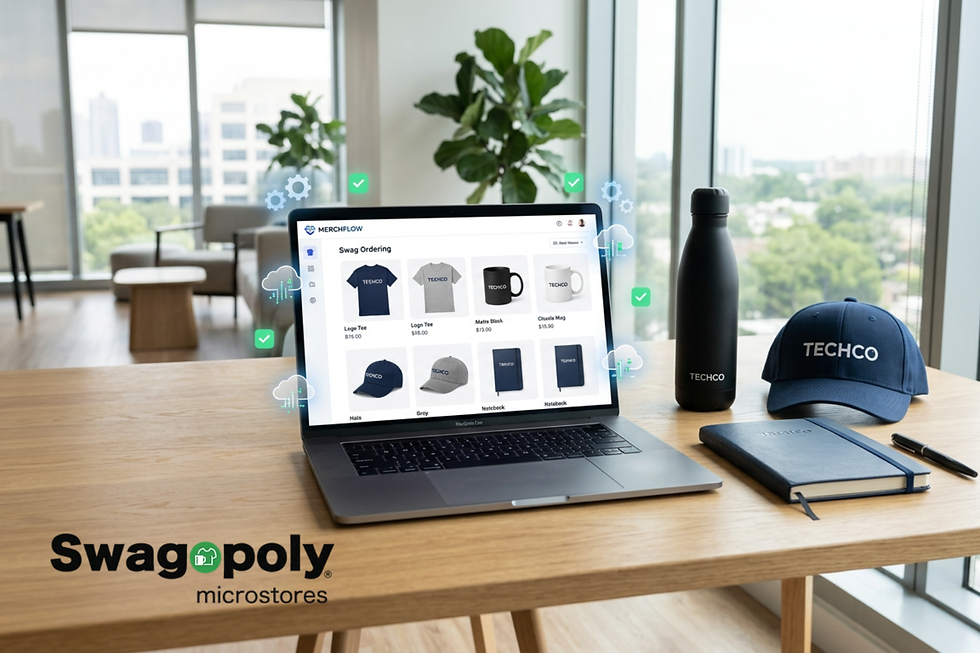
At the center of this system is a company swag store, often built as a branded microstore. This acts as the hub where all merchandise lives.
Instead of requesting items through internal teams, employees or customers can access the store directly. They choose what they need, place an order, and the system handles everything else.
Behind the scenes, automation takes care of:
Product availability
Order processing
Production using on-demand methods
Packaging and shipping
There’s no inventory to track and no manual coordination required.
Step 1: Centralize Your Swag Into One System
The first step in building an automated swag system is consolidation.
Most companies have swag scattered across different departments. HR manages onboarding kits, marketing handles event merchandise, and operations deal with inventory.
This fragmentation creates inefficiency.
By moving everything into a single company branded microstore, you create a centralized system where all products, designs, and orders are managed in one place.
This not only simplifies operations but also ensures brand consistency across every item.
Step 2: Replace Inventory with On-Demand Production
Inventory is one of the biggest barriers to automation.
As long as you rely on bulk ordering, you’ll need storage, tracking, and manual distribution. Automation becomes limited because the system still depends on physical stock.
Switching to print-on-demand apparel removes this constraint.
Products are created only when an order is placed. This means:
No overproduction
No unused inventory
No need to predict demand
It also allows you to update products or designs instantly without worrying about leftover stock.
Step 3: Enable Self-Service Ordering
In a manual system, every request flows through a person or team.
In an automated system, users serve themselves.
Employees, customers, or partners can access your company swag store, browse available products, and place orders directly. This eliminates the need for internal coordination and reduces delays.
It also improves the experience. Instead of receiving generic items, users can choose what they actually want, in the right size and at the right time.
Step 4: Automate Fulfillment and Distribution
Once an order is placed, the system should handle everything automatically.
This includes:
Sending the order to production
Creating the product using on-demand methods
Packaging and shipping it to the correct address
Modern swag systems integrate fulfillment into the process, so there’s no need for internal teams to manage logistics.
This is especially important for companies with remote or global teams, where manual distribution becomes complex and time-consuming.
Step 5: Maintain Control Through a Central Dashboard
Automation doesn’t mean losing control. In fact, it gives you more visibility.
A well-built system allows you to manage:
Product catalogs
Branding and design updates
Order activity
Usage trends
This ensures that your swag program remains aligned with your brand while operating efficiently in the background.
The Real Benefit: From Workload to Workflow
The biggest advantage of automation is not just efficiency, it’s transformation.
Manual swag management is task-driven. Teams react to requests, solve problems, and manage logistics.
Automated swag systems are workflow-driven. Once set up, they run continuously without constant intervention.
This shift allows teams to:
Focus on strategy instead of operations
Scale without increasing workload
Deliver consistent brand experiences
Instead of managing swag, you manage a system that handles it for you.
Real Insight: What We See in Growing Companies
Most companies don’t set out to build a complex swag system, it evolves.
As teams grow, processes become layered, and what was once simple turns into a mix of spreadsheets, emails, and manual tasks.
The turning point comes when the cost of managing swag outweighs its value.
That’s when businesses start looking for automation, not as a convenience, but as a necessity.
Why This Matters in 2026
The modern workplace is distributed, fast-moving, and data-driven. Systems that rely on manual coordination can’t keep up.
Automation is no longer optional. It’s the standard for businesses that want to operate efficiently and scale without friction.
Swag is no exception.
Companies that adopt automated swag systems are not just improving operations, they are building infrastructure that supports long-term growth.
How Swagopoly Helps You Build This System
At Swagopoly, we’ve designed our platform to support this exact transition.
Instead of managing swag manually, businesses use:
Company branded microstores to centralize their merchandise
Print on demand apparel to eliminate inventory
Automated fulfillment to handle production and shipping
This creates a complete system where swag is no longer a task, it’s a streamlined process.
Whether you’re managing onboarding kits, running a company swag store, or creating an employee uniform store online, everything works together seamlessly.
Final Thoughts
Building a fully automated company swag system isn’t about adding more tools, it’s about removing friction.
By centralizing your program, eliminating inventory, and automating fulfillment, you create a system that is efficient, scalable, and aligned with how modern businesses operate.
The result is not just better swag management, it’s better business operations.
Real Questions Businesses Ask
What is a fully automated swag system?
It’s a system where ordering, production, and delivery of swag are handled automatically without manual coordination.
Do I still need inventory with automation?
No. With print-on-demand, products are created only when ordered, eliminating the need for storage.
Can automated swag systems work for remote teams?
Yes. They are especially effective for distributed teams because they simplify global ordering and delivery.
How does a company swag store help automation?
It centralizes all products and allows users to order directly, reducing internal workload.
Is automation difficult to set up?
Not with the right platform. Once implemented, the system runs with minimal ongoing effort.
Comments